Get it off the ground
Wood stacked directly on soil or grass wicks moisture back up from the ground and stays damp at the base no matter how long it sits, per extension guidance on firewood drying and storing. Pallets, 2×4 rails, or any raised base that lifts the bottom row a few inches off the dirt lets air circulate underneath and stops that reabsorption.
This matters most for the bottom third of a stack — those pieces will consistently read wetter on a moisture meter than the rest of the pile if they were stacked straight on the ground.
Prioritize airflow over shelter
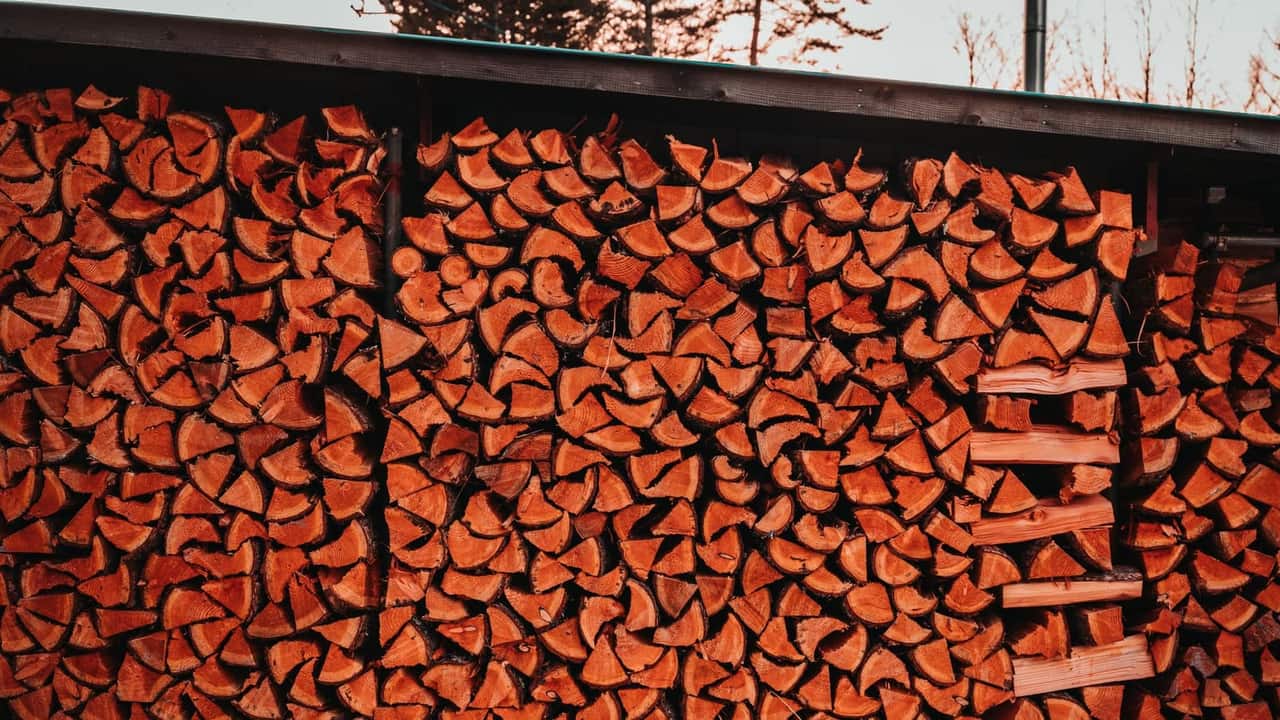
A single row, split face out, with open space on both long sides dries far faster than a wide, tightly packed block, because moving air is what actually carries moisture away — sunlight and warmth help but airflow does the heavy lifting. Orienting the row to catch prevailing wind and afternoon sun speeds things up further.
Rows spaced a few inches apart, or stacked criss-cross at the ends for stability, keep more surface exposed to air than one dense block of the same total volume.
- Single row, split face out — not a wide, tightly packed block.
- A few inches of open space on both long sides of the row.
- Orient the row to catch prevailing wind and afternoon sun.
- Criss-cross the end pieces for stability instead of boxing the row in.
Cover the top only
Rain and snow on top of a stack are the main threats — but wrapping a tarp around all four sides traps humidity inside the pile and can slow seasoning more than leaving it uncovered entirely. Cover just the top few inches, leaving the sides fully open to air, and weight the tarp down so wind doesn't undo it.
Once a cord is properly seasoned (see what "seasoned" is supposed to mean for the moisture target and how to check it), the same top-only covering keeps it dry through winter use.
Frequently asked questions
How to stack firewood to dry fastest?
Get it off the ground on pallets or rails, stack a single row split face out with a few inches of gap for airflow, orient it to catch prevailing wind and afternoon sun, and cover only the top. That combination commonly dries wood in roughly half the time of a loose pile or a fully tarped block.
Does stack height matter for seasoning speed?
A very tall, dense stack has less exposed surface area relative to its volume, which can slow drying slightly compared to a longer, single-row stack of the same total wood — height itself is less important than airflow around each piece.
Should firewood be stacked against a house wall?
It is common practice, but leave a gap of a few inches rather than pushing it flush against siding, both for airflow and to avoid trapping moisture against the building.
How much does proper stacking actually speed up seasoning?
Well-stacked wood with good airflow and top-only covering commonly reaches seasoned moisture in roughly half the time of the same wood piled loosely or fully tarped, though exact gains vary by species and climate.